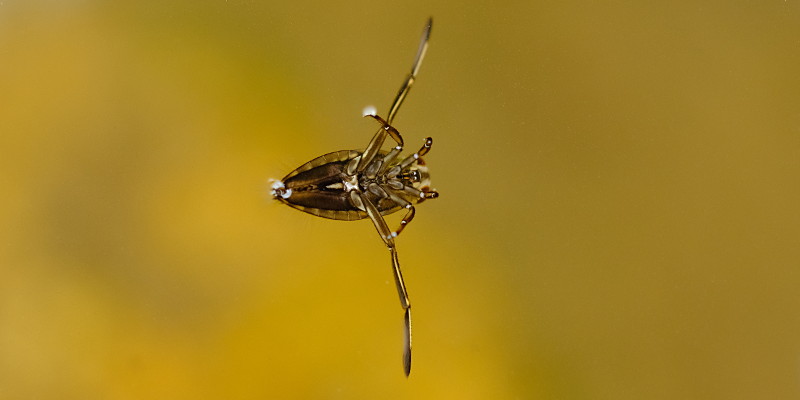
Common Backswimmer Notonecta glauca just beneath the surface of the pond.
In my garden I have a small pond, with a freshwater feed from a spring. It was created by the previous owners about 40 years ago, originally as an ornamental feature with exotic fish and very little else. Since moving here, over the past 20 years I have allowed the wild flora and fauna to establish itself and the pond is now a haven for wildlife. I've often wondered about the pond's underwater soundscape and how I might go about listening. Unlike taking a walk in the woods to listen to birdsong, it's not possible to experience directly the sonic wonders of the underwater world without the use of modern technology.
By lowering an underwater microphone into the pond on a summer's day, amidst the fizzing sound from oxygenating plants, it's generally possible to hear bursts of rhythmic ticking. These range from single ticks once every 10 seconds or so, to a frequency of around 10Hz (10 per second), with various patterns and speed changes also apparent. Together with chirps of higher pitch, the trickle of water and the rasping of pond snails, there is an amazing variety of sound.
Adult pond beetles and bugs of the orders Coleoptera and Hemiptera are responsible for most of the regular ticking; they make these sounds by means of stridulation and other similar mechanisms in which they rub together legs and other adapted body parts. The significance of the individual sounds is not yet fully understood, but some probably act as mating or warning calls, and seem to be used for other communication purposes, too.
So far, I have visually identified: Whirlygig Beetle, Gyrinus substriatus; Great Diving Beetle, Dytiscus marginalis; Lesser Water Boatman, Hesperocoryxa linnaei; Saucer Bug, Iliocoris sp; Common Backswimmer, Notonecta glauca. There are also a lot of tiny beetles which I've yet to identify. I have been hoping that I might be able to identify species by means of analysis of the sounds, as clearly the little critters themselves make some sense of them. I've found a few studies of individual species of coleoptera, but there's not much general literature available, so this is likely to become an ongoing project. Until then, I have no idea whether the Common Backswimmer pictured above is responsible for any of the sounds heard here or not!
In the meantime, when presented with the unfamiliar, we humans are inclined to interpret things in terms of what we know. Listening to the variety of sounds, it's easy to label them "scissors beetle" "motor-boat" and "clock tick", just three which you will hear.
The sound montage presented here has been constructed from two layered recordings, both made in June 2020 with a home-built hydrophone. My aim in this case is not to capture "reality" as such, but to create a naturalistic portrayal of an alien soundscape.
Technical note
I'll mention a few things here since this soundscape is a departure from the other recordings in this section and is also technically more complex.
The centre channel is a single continuous recording from a fixed location in the pond, with the hydrophone suspended above a clump of vegetation. This is where the action lies, and it is dominated by the sounds of beetle communications. It's been edited to remove extraneous noise, due to my moving the boom pole, enthusiastic newts, and excessive clipping, etc. More importantly, in order to hear the detail in the quieter, and more distant calls, the dynamics of the louder beetle "clicks" have been reduced by up to 40dB, and they're still quite loud! Pond beetles are sometimes referred to as "the loudest creatures on earth", which they might well be relative to their size, and the original recording was quite painful to listen to. I've also heavily filtered the original to compensate for the inadequacies of my home-built hydrophone.
Although the main focus is on the centre channel, the left and right channels provide a contextual ambient backdrop. These originated as a recording made in the same pond, but away from the louder beetle calls, where the sounds of oxygenating vegetation and trickle of water is more clearly heard. This ambient recording has been looped and split between left & right channels, each also containing a 1ms delayed crossfeed of the other. The crossfeed is an important element, since it effectively re-creates arrival-time spatial cues and moves the localisation away from the loudspeakers (or away from your individual ears if using headphones), and gives a more diffuse and enveloping sense to the sound.
Recorded: 2020-06-02 @ noon
Approximate location: 52.2,-3.5
 Download full length recording:
17min, 33MB, .ogg format
Download full length recording:
17min, 33MB, .ogg format

This work is licensed under a Creative Commons Attribution-ShareAlike 4.0 International License.